If proof were needed that handmade is cool again, look no further than Liberty. The London department store has doubled the size of its fabrics department and is preparing to host craft classes this autumn.
It’s a neat example of digital and physical meeting in the middle. The surge in crafts like quilting and crocheting is partly fuelled by TikTok, Facebook, and Instagram walkthroughs, alongside television programmes like The Great British Sewing Bee. But at Sunday, we like to think it’s more than that. It is a quiet rebellion against AI-generated perfection and a deliberate pivot back to human imperfection.
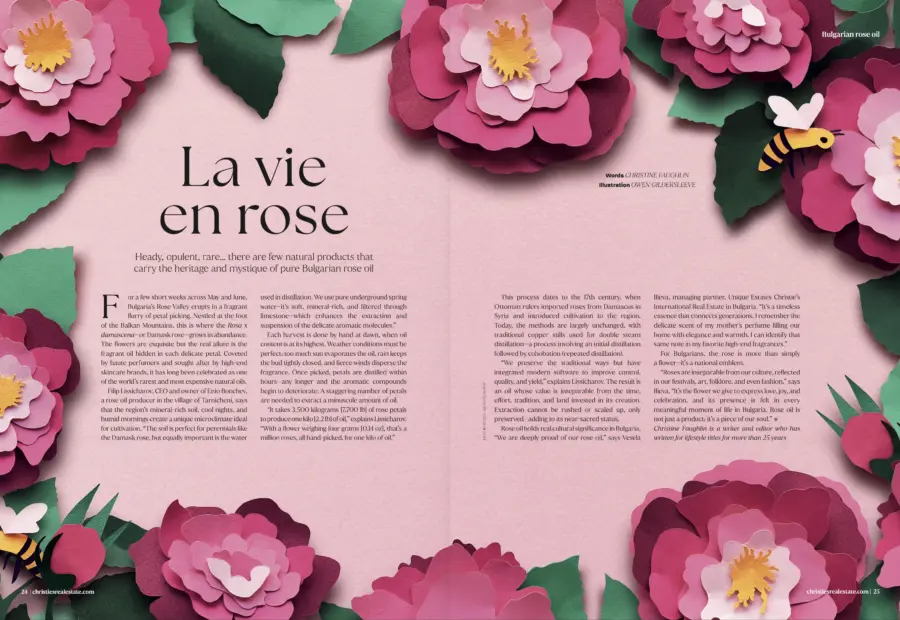
One of the reasons our content cuts through is that it is (almost always) strictly human made. Our teams invest hours tracking down ideas, commissioning pieces, and agonising over creative execution. It is how we decided on the hand-crafted approach to the Bulgarian Rose oil feature for Christie’s International Real Estate and the hydrography piece for the Royal Institution of Chartered Surveyors. [AS2.1]We commissioned the same artist to illustrate both pieces of content from paper – for completely different subject matter. You can see the hand in it. That is the entire point.
We’d argue that this visible effort is the new luxury signal. It shows that creativity was not rushed, templated or auto generated. Instead it was thought through, argued over and crafted by people who care about how it lands.
It used to be enough to show the final creative – the ta-dah moment that a team would have spent hours working towards. Today, clients increasingly want to see the workings; they want all the stuff behind-the-scenes that agencies used to hide. They want to see what failed. They want to understand how the end result was reached. Creativity is now as much about the journey as it is the destination because it is proof that time and care has been spent.
Luxury brands have long understood that handmade is what sets them apart. Hermès consistently commissions international artists to build its beautiful window displays. They are crafted entirely from folded paper, carved wood, ceramics and hand-stitched leather. It is a powerful way of communicating the hand of the maker and that time and passion matter.
Bottega Veneta’s Craft Is Our Language campaign celebrated heritage and innovation. And Tod’s did a similar thing with its Artisanal Intelligence to highlight its ongoing commitment to Made In Italy.
Other brands use handmade or human-made as a way of creating trust with their audience. The New York Times is as well-known for its highly creative out of home installations as it is for serious journalism. Lush builds physical retail brand experience and marketing assets around human touch. It features handwritten product labels and drawings on the pots.
None of this is about rejecting technology advances. It’s about finding out where technology – and in particular AI – fits in. It is about confidence that a brand is being handled with human intelligence and not just algorithmic efficiency.
So, bring on the craft classes, the hand drawn and human made. In an age of infinite content, human is the ultimate strategic advantage for brands.